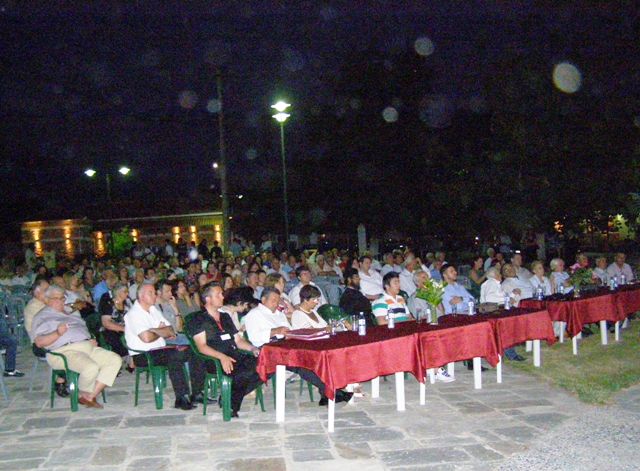
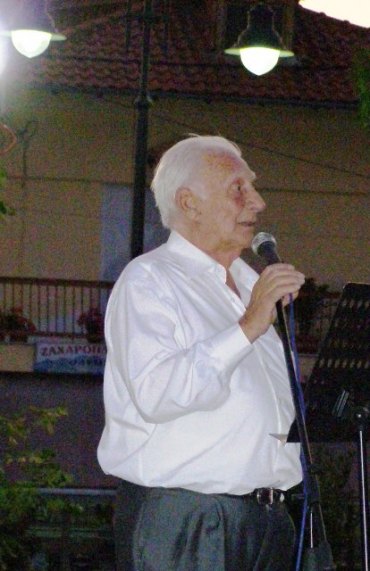
The investigation of human origins constitutes one of the most complex and multifaceted fields of scientific inquiry. Within the framework of the 4th Perrhaebian Tripolis Festival in Doliche in the summer of 2011, the distinguished anthropologist and researcher of the Petralona Cave, Aris Poulianos (1924–2022), presented his radical positions on anthropogenesis. This lecture, recorded by cultural scholar Evangelos Tsaknakis, offers a concise overview of a theory that challenges the dominant scientific paradigm.
Challenging the “African Theory”
A central pillar of Poulianos’s argumentation was the rejection of the widely accepted theory that the human species first appeared in Africa approximately 2.5–3 million years ago. According to Poulianos, Charles Darwin committed a fundamental error regarding both the timing and the geographical locus of anthropogenesis.
The Greek anthropologist argued that this process began much earlier—around 13 million years ago—with southeastern Europe, and more specifically the Greek region, as its epicenter. According to this hypothesis, early humans spread from Greece to the rest of the world, acquiring different morphological characteristics (such as skin color) through adaptation to diverse environments.
The “Graecopithecus” and Biocultural Evolution
The theoretical foundation of Poulianos’s views rests on the discovery of Graecopithecus. According to the researcher:
- Graecopithecus lived in Euboea approximately 13 million years ago and represents the earliest being to exhibit characteristics of upright posture.
- The transition from arboreal life to terrestrial existence was triggered by intense volcanic activity, forcing human ancestors to adapt to new environments.
- Upright posture was not merely a biological change but the catalyst for the development of cognition, language, and culture.
Poulianos firmly maintained that the Greeks constitute an autochthonous population with roots extending back millions of years, thereby refuting theories of later migratory waves from the North or from Africa.
Science, Religion, and International Reception
Poulianos did not hesitate to address the issue of the relationship between science and religion. While expressing respect for the clergy, he argued that God is a human construct that evolved alongside human cognition. In his view, the science of anthropology must be accessible to society as a whole and not confined to a closed circle of specialists.
Regarding the scientific reception of his views, he noted that his findings were presented at international conferences (such as those in China) before thousands of colleagues, sparking considerable interest and debate. At the same time, he emphasized the importance of keeping discoveries—such as the Petralona bones—within Greece, as a means of safeguarding cultural heritage.
Conclusion
Aris Poulianos’s lecture in Doliche constituted a “life testimony” and a challenge to entrenched scientific thought. Although his theories remain subjects of debate and, often, controversy, his effort to link the Greek region with the origins of humanity highlights anthropology as a dynamic process of continuous re-examination of our sources and data.
 DOLICHE
Σχολιάστε