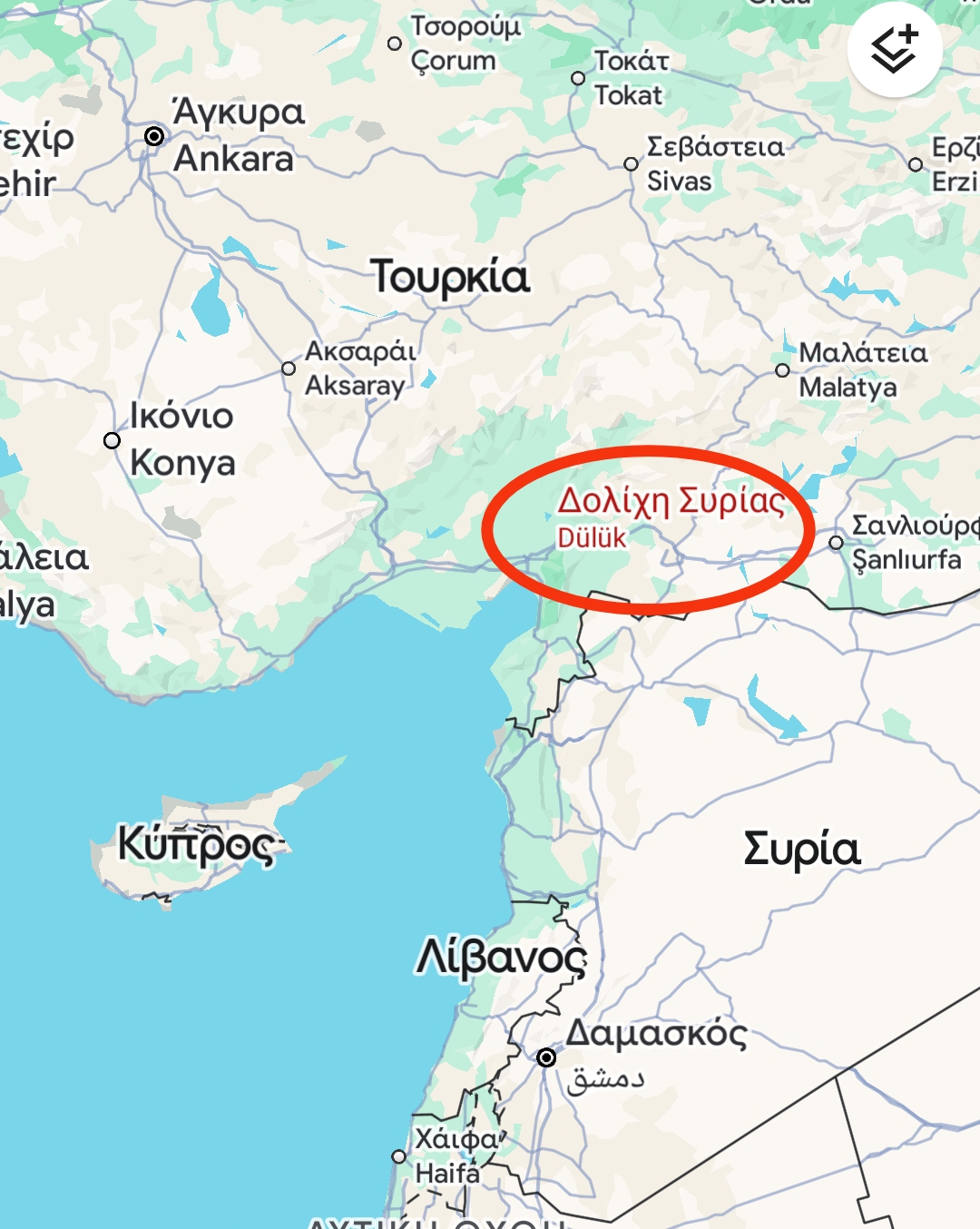
Getzel M. Cohen examines Doliche in Syria (Commagene; location: modern Dülük in Turkey) within the framework of Seleucid policies of naming and colonization. He argues that the toponym “Doliche” most likely derives from the homonymous city of Perrhaebia in northern Thessaly, fitting into a broader and deliberate Seleucid practice—especially under Seleucus I Nicator—of transferring Greek and Macedonian place names to the East. The aim of this practice was to create a sense of familiarity among the settlers and to consolidate the new authority both ideologically and politically.
Within the same framework, Cohen dates the foundation of the city to the period of the Diadochi, assuming that settlers were transferred directly from the mother cities whose names were adopted. In his interpretation, naming functioned as a means of “recreating the landscape of the homeland” within the new territory. At the same time, however, he also presents the opposing view of Grainger, according to which the name “Doliche” is not an imported Greek toponym but rather a Hellenized form of the local name Dülük.
Michael Blömer, Dilek Çobanoğlu, and Engelbert Winter, drawing on excavation data, point out that the hypothesis of a Seleucid foundation rests primarily on the onomastic “correspondence” between the city and Thessalian Doliche. At the same time, they emphasize the strategic importance of the city’s location, situated at a key junction of trade routes linking Mesopotamia with the Mediterranean world—a factor that accounts for the strong Seleucid interest in the region. Although written sources are limited, archaeological research demonstrates a clear transformation of the city during the 2nd century BC, marked by the adoption of Greco-Roman urban and cultural models.
In a later study on the “biographies of cities,” Blömer undertakes a substantial reassessment of both the chronology and the nature of the Hellenization of Doliche. Archaeological evidence from the sanctuary on the hill of Dülük Baba Tepesi reveals strong continuity of pre-Hellenistic cultic and material traditions, as well as the absence of Hellenistic pottery until the mid-2nd century BC. On the basis of these findings, he suggests that Doliche should not necessarily be regarded as a newly founded, “disembedded” settlement of Seleucus I, but rather as a pre-existing community that gradually evolved into a Hellenistic city, possibly without an initial large-scale settlement of Greeks or Macedonians.
Blömer agrees that the naming of cities such as Doliche, Beroia, and Larisa formed part of the Seleucid effort to recreate the landscape of the metropolis. He stresses, however, that a change of name did not automatically entail an immediate and complete transformation of local society and identity.
The position of Grainger, as cited by both Cohen and Blömer, focuses on the local origin of the name. According to this view, “Doliche” emerged from the phonetic and morphological adaptation of the indigenous name Dülük to Greek linguistic norms, without any necessary connection to a Thessalian colony.
Conclusion
The disagreement among scholars highlights two distinct methodological approaches. Cohen places emphasis on naming practices as evidence of an imperial strategy involving the transfer of populations and cultural models from the Greek world. By contrast, Blömer, drawing on excavation data, demonstrates that Doliche remained deeply connected to its local roots for a considerable period before fully adopting a Hellenistic form.
Bibliography
• Michael Blömer, Dilek Çobanoğlu & Engelbert Winter, «Die Stadtgrabung in Doliche. Zu den Ergebnissen der Feldarbeiten 2015–2018«, Istanbuler Mitteilungen, Band 69, 2019, Gebr. Mann Verlag Berlin.
• Getzel M. Cohen, The Hellenistic Settlements in Syria, the Red Sea Basin, and North Africa, University of California Press, 2006.
• Michael Blömer, «Observations on Cities and their Biographies in Hellenistic North Syria», Journal of Urban Archaeology, Vol. 2, 2020, Brepols Publishers.


Σχολιάστε